Why Seller Ratings, Recent Reviews, Sales Volume, and Dispute Records Should Be Reviewed Together
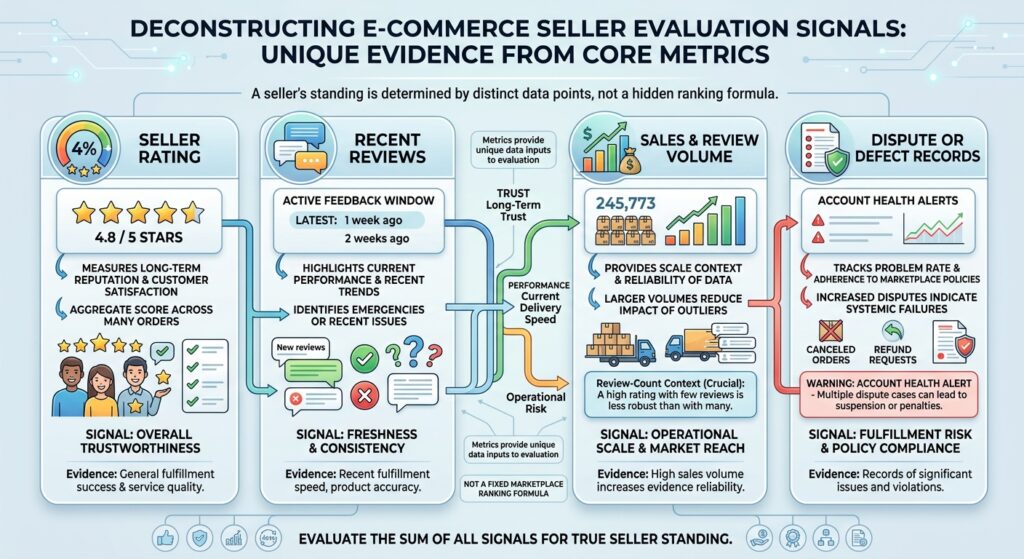
Star ratings are useful, but they cannot show the full condition of a seller or product. A high average may be based on a small number of ratings, reflect an older version of the product, or hide a recent pattern of shipping and service complaints. Seller ratings, product reviews, sales volume, and dispute records also measure different things. Product reviews usually describe the item. Seller feedback focuses more on fulfillment and customer service. Sales volume shows how much transaction history exists, while dispute and defect metrics indicate whether orders are ending in unresolved problems. Marketplace definitions are not universal. Amazon, eBay, Shopee, Lazada, and TikTok Shop use different standards, evaluation periods, enforcement procedures, and public displays. Buyers should therefore use the four signals as a practical screening method rather than assuming they form one universal ranking formula.
Detailed Explanation of the 4 Core Metrics: Seller Ratings, Recent Reviews, Sales Volume, and Dispute Records
To evaluate a seller properly, first identify what each displayed number measures. A product’s star average is not necessarily the seller’s service rating, and neither number provides direct access to the marketplace’s internal account-health data.
Seller Ratings: A Record of Service, Not a Universal Operational Certificate
Seller ratings generally reflect customer feedback about the transaction, including delivery, communication, packaging, or whether the item matched the listing. The exact calculation depends on the platform. It is inaccurate to claim that every seller rating is calculated from on-time delivery, cancellation rate, and 24-hour response rate. A marketplace may track those factors separately even when buyers see only a public feedback score.
Amazon’s Order Defect Rate, for example, is a seller-performance metric connected to negative feedback, A-to-z Guarantee claims, and service chargebacks. Amazon separately tracks fulfillment measures such as valid tracking and on-time delivery. eBay uses its own seller standards, including transaction defects, late shipments, tracking performance, and cases closed without seller resolution. Seller performance may affect account status and the ability to compete effectively, but no public rule supports the claim that a score below 95% automatically removes the Amazon Buy Box.
Amazon now calls the Buy Box the Featured Offer. In July 2026, Amazon announced that it had begun gradually removing the separate seller eligibility requirements for the Featured Offer across its stores, with global completion planned by the end of 2026. Price, availability, delivery speed, and customer service can still affect which offer is displayed.
Recent Reviews: Evidence of Current Product and Service Conditions
Recent reviews can reveal changes that an overall average hides. A product may retain a 4.8-star score even after a new production batch introduces sizing problems, weaker materials, damaged packaging, or missing accessories. Buyers should read several of the newest critical and positive reviews. Repeated complaints are more meaningful when they describe the same specific problem, identify the same product variation, and come from verified or otherwise credible purchases.
A few negative reviews do not prove that a seller has become unreliable. The buyer should examine whether the complaints concern the product, the seller, the delivery company, or a misunderstanding about the listing.
There is also no verified universal rule that five or ten recent one-star reviews automatically trigger an internal quality flag or ranking reduction. Marketplaces do not publish complete search-ranking formulas, and the effect of reviews can differ by category, market, listing history, price, availability, and other factors. Recent feedback is therefore best used as a current-risk indicator, not as proof of a specific algorithmic penalty.
Sales Volume and Review Volume: Context for the Average Score
Review volume gives the star average statistical context. A five-star rating based on three reviews does not carry the same evidence as a 4.7-star rating based on several thousand independent ratings.
Baymard Institute’s product-page research found that users had difficulty assessing the reliability of an average when the number of ratings was not shown. Its testing supports displaying and considering both the average score and the number of ratings. Sales volume can also show that a seller has handled a substantial number of transactions. It does not prove that every transaction was successful, that current inventory matches older inventory, or that the seller will resolve a future problem properly.
High volume should not be described as an “algorithmic shock absorber.” A large number of historical sales may make a small number of new reviews less visible in the mathematical average, but marketplaces can still act on policy violations, complaint patterns, counterfeit concerns, or fulfillment failures. Buyers should compare sales and review volume carefully. A listing showing thousands of sales but very few detailed reviews may deserve additional examination, especially when recent reviews are repetitive, vague, or unrelated to the product.
Dispute Records: Important Internal Metrics With Limited Public Visibility
Disputes may include payment chargebacks, marketplace guarantee claims, unresolved returns, refund cases, or complaints that require platform intervention. These records matter to sellers and marketplaces, but buyers usually cannot see a seller’s complete dispute history. Amazon states that sellers should maintain an Order Defect Rate below 1%. Excessive negative feedback, A-to-z Guarantee claims, and service chargebacks can place an account at risk and may lead to suspension or closure. This is not the same as an automatic rule that every account exceeding 1% is immediately and permanently suspended.
Other marketplaces use different thresholds. eBay’s seller standards, for example, separately measure transaction defects and cases closed without seller resolution. Its published thresholds are not interchangeable with Amazon’s ODR standard. Buyers who cannot access internal dispute data can look for indirect evidence: repeated reports of refused refunds, unresolved delivery problems, seller responses that blame customers without investigation, or complaints stating that the platform had to intervene.
Consequences of Metric Mismatch: Hidden Traps Behind an Attractive Star Rating
A seller can appear reliable when one metric is viewed alone. Problems become easier to identify when the public rating is compared with review dates, transaction volume, complaint patterns, and available seller-performance information.
The “High Stars, Rising Disputes” Trap
A strong historical rating can remain visible while recent customers experience delayed refunds, incorrect items, or damaged orders. Because the overall rating changes slowly when thousands of older reviews exist, the current problem may first appear in recent review text.
This does not prove that the seller’s ODR has exceeded a specific percentage or that permanent suspension will follow. Buyers do not normally have access to that internal data. The safer conclusion is that repeated unresolved complaints increase purchase risk even when the displayed average remains high. Sellers should also avoid gifts, rebates, or other benefits conditioned on positive reviews. Incentivized or manipulated reviews may violate marketplace rules and consumer-protection law.
Silent De-Ranking
A sudden decline in search placement cannot be attributed to five negative reviews without platform data. Search position can change because of price, conversion performance, inventory, delivery estimates, advertising, seasonality, relevance, policy restrictions, or competition. The original claim that a listing will fall from page one to page five within 48 hours is unsupported. Sellers should compare impressions, clicks, conversions, inventory status, pricing, advertising, and account-health notices before identifying a cause.
Loss of Featured Offer Control
Fulfillment failures can reduce an offer’s competitiveness. Late deliveries, unavailable inventory, uncompetitive pricing, poor customer service, and policy problems can all matter. However, the rules are changing. Amazon announced in July 2026 that it was gradually removing separate Featured Offer seller-eligibility requirements. Sellers should rely on their current marketplace dashboard and local Amazon guidance rather than older articles stating that a fixed seller-rating threshold automatically controls Featured Offer access.
Integrated Conversion Funnel: How the Metrics Influence Visibility, Clicks, and Purchases
The four metrics can affect different parts of the shopping process, but they do not form a published universal formula.
Stage 1: Visibility
Primary Signals: Platform-Specific Performance, Relevance, Price, Availability, and Sales History
A marketplace may consider product relevance, competitive price, stock availability, fulfillment performance, customer experience, and sales activity when distributing listings. Seller rating and sales volume can contribute to credibility, but they should not be described as the two confirmed primary ranking factors across every marketplace. Complete ranking algorithms are generally proprietary.
Stage 2: Click-Through Rate
Primary Signals: Star Average, Review Count, Price, Image, and Delivery Information
In search results, shoppers often compare the rating average with the number of ratings. A 4.8-star product with a meaningful review history may appear more credible than a perfect score based on one or two ratings. Price, product image, discount presentation, shipping time, and brand recognition also affect whether a shopper opens the listing. Review data is one part of the decision rather than a guaranteed driver of click-through rate.
Stage 3: Conversion Rate
Primary Signals: Recent Review Content, Product Fit, Seller Terms, and Purchase Protection
Once shoppers open a product page, recent reviews can help them evaluate current quality, sizing, packaging, delivery, and seller support. A “clean dispute history” cannot usually influence conversion directly because buyers cannot see complete backend dispute records. What they can assess is the visible pattern of complaints, seller responses, return terms, buyer-protection rules, and whether recent customers report successful resolutions.
Why a Standalone Star Rating Score Is Not Enough
The original 69% statistic was misrepresented. BrightLocal reported that 69% of surveyed consumers would feel positive about using a local business when its written reviews described positive experiences. It did not report that 69% distrust products displaying a standalone perfect star rating. The broader concern remains valid: an average score provides too little context when the review count, dates, written comments, and rating distribution are missing.
Fear of Fake or Manipulated Reviews
Consumers know that reviews can be purchased, exchanged for gifts, submitted by fake accounts, or manipulated by suppressing unfavorable feedback. Amazon states that it uses machine-learning systems and other data to detect suspected fake reviews, manipulated ratings, fake accounts, and risky behavior before reviews appear. That enforcement effort also shows why buyers should not assume every visible rating is automatically trustworthy.
Time Mismatch
A rating collected several years ago may describe a different product version, supplier, package design, or fulfillment process. Review dates and product variations help buyers decide whether old feedback still applies.
Authenticity in Imperfect Reviews
Two- and three-star reviews can be especially useful because they often describe both strengths and weaknesses. They may reveal whether a limitation is serious or simply a matter of personal preference. Seller responses also provide evidence. A calm response that explains the resolution process is more useful than an aggressive response, but a seller’s reply alone does not prove that the customer received a refund or replacement.
The Trap of Fake Reviews and the $4.2 Million Price Tag From Review Manipulation
Manipulating reviews can create platform, reputational, and legal risk. The consequences depend on the jurisdiction, marketplace policy, conduct, and evidence.
The $4.2 Million FTC Enforcement Settlement
In 2022, the U.S. Federal Trade Commission finalized an order requiring Fashion Nova to pay $4.2 million to settle allegations that it blocked negative product reviews from appearing on its website. The order also prohibited the company from misrepresenting customer reviews. The case involved the alleged suppression of hundreds of thousands of lower-star reviews. It should not be described as a standard fine automatically imposed whenever a company moderates reviews.
Amazon’s Enforcement Against Review Abuse
Amazon prohibits activity intended to manipulate customer reviews. The company has described using automated systems, investigators, legal action, and cooperation with other organizations to combat review abuse. In 2022, Amazon announced legal action against administrators of more than 10,000 Facebook groups allegedly used to coordinate fake reviews in exchange for money or free products.
Specific claims that named brands were permanently removed for particular inserts or gift cards should be supported by official notices or reliable case records before publication. A general article should not present rumors about individual sellers as established fact. The FTC’s Consumer Reviews and Testimonials Rule took effect on October 21, 2024. It covers conduct such as buying or selling fake reviews and allows courts to impose civil penalties for knowing violations.
Key takeaway for brands: Suppressing genuine negative reviews, buying fabricated feedback, or conditioning rewards on positive ratings can violate marketplace rules and consumer-protection requirements. A safer approach is to request honest feedback without controlling the rating and to resolve recurring product or service failures.
FAQ
Why should consumers not rely on a standalone star rating?
A star average does not reveal how many ratings exist, when they were submitted, which product variations they cover, or whether recent customers are reporting a repeated problem. Review count, dates, written feedback, and rating distribution provide the missing context.
Why examine four seller metrics together instead of looking at star rating alone?
Each marketplace metric provides a different perspective on a seller’s reliability and performance. Seller ratings reflect the experiences of previous customers and offer a general indication of service quality, while recent reviews help identify current issues with products, shipping, or customer support that may not be reflected in the overall rating. Sales volume and the number of reviews indicate how much purchasing history supports the displayed average, making it easier to judge whether a rating is based on substantial customer feedback. Meanwhile, dispute records and defect metrics can reveal operational risks or recurring service problems, although detailed information about these records is often available only to the seller and the marketplace platform.
Reviewing the four signals together helps buyers distinguish a genuinely established seller from a listing that merely has an attractive average score. It also helps sellers identify whether product quality, fulfillment, service, or dispute handling requires attention.